
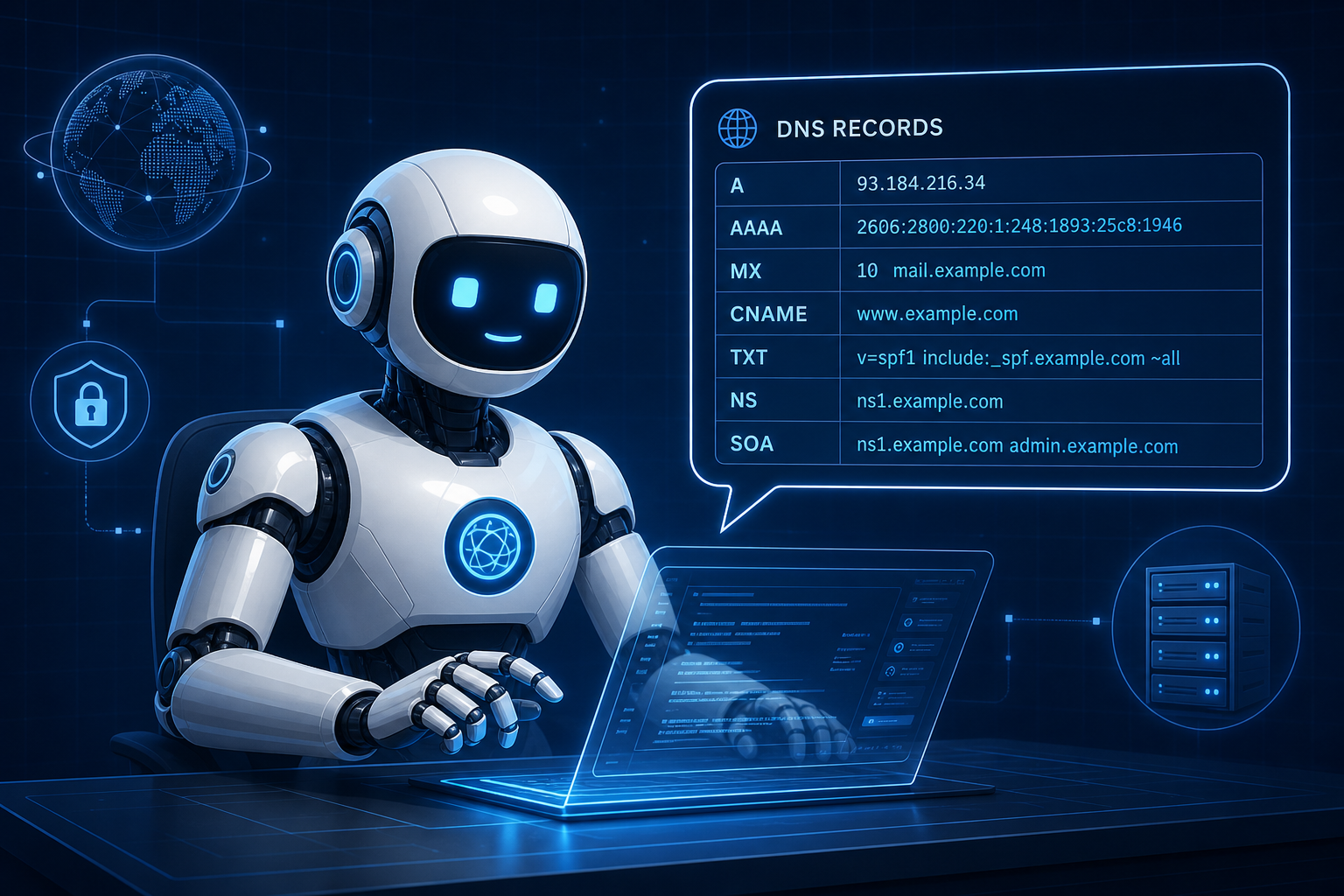
The Problem With DNS Monitoring Today
DNS monitoring should be simple. You want to know if something changed. You want to know if a record propagated. You want to know if a phishing site just went live with your brand name in the domain.
But in practice it takes work. You log in to a dashboard. You click through menus. You run a check, copy the output, paste it somewhere else. You repeat that process every time someone on the team asks a question.
AI assistants like Claude and ChatGPT could help. They are good at reading complex data and explaining it fast. The problem is they have no access to your live DNS data. You end up copying and pasting anyway. The AI becomes a writing tool, not a real assistant.
That is the problem DNS Spy's new MCP Server solves.
What Is MCP? (Plain Language Version)
MCP stands for Model Context Protocol. It is an open standard that lets AI assistants connect to real tools and data. Think of it like a plugin system for your AI. Instead of the AI only knowing what is in its training data, it can call out to live services and get real answers.
You configure your AI client once, point it at a server, and the AI gains access to a set of tools it can call during a conversation. Ask the AI a question, it picks the right tool, calls it, reads the result, and tells you what it found. You never leave the chat window.
What DNS Spy's MCP Server Does
The DNS Spy MCP Server gives your AI assistant access to the entire DNS Spy platform through 50+ purpose-built tools. Every feature you use in the dashboard is now something your AI can call in plain language.
Here is what the AI can do:
List and inspect monitored domains, nameservers, DNS records, and full change history
Pull Security Center scores and per-check results, with explanations for every finding
Surface phishing look-alike domains, their threat scores, and hosting infrastructure
Run live DNS lookups from distributed query nodes worldwide
Check propagation across approximately 40 public resolvers and stream progress live
Inspect SSL/TLS certificates and flag upcoming expirations
Run WHOIS and RDAP lookups on any domain
Check SPF and DMARC records and flag weak configurations
Every tool call is logged. Every action is tied to your API credit quota. Read-only tools are flagged safe. Write tools are flagged so your AI client can confirm before making changes.
What You Can Actually Ask It
Here are real prompts you can send to your AI assistant once it is connected to DNS Spy:
"Audit example.com and list the highest-priority security fixes."
"Has the new A record for www.example.com propagated worldwide yet?"
"Show me active phishing look-alikes of our brand and which ones have live mail servers."
"Which of our domains or SSL certificates expire in the next 30 days?"
"Check the SPF and DMARC records for example.com and flag anything weak."
You get a plain-language answer. The AI calls the right tools behind the scenes. You do not need to know which feature to use or where to find it.
How to Connect in Minutes
Setup takes one step. Add this JSON block to your MCP client configuration and replace YOUR_API_TOKEN with your DNS Spy API key:
{
  "mcpServers": {
    "dnsspy": {
      "url": "https://dnsspy.io/mcp",
      "headers": {
        "Authorization": "Bearer YOUR_API_TOKEN"
      }
    }
  }
}
That is it. No SDK to install. No webhook to configure. Point your MCP client at the DNS Spy endpoint, authenticate with your existing API key, and start asking questions.
The MCP server works with Claude (desktop and web), MCP-enabled ChatGPT connectors, IDE assistants, and any custom agent built with the Anthropic or OpenAI SDKs.
Who This Is Built For
The DNS Spy MCP Server is an Enterprise feature. It is built for teams that already run AI-assisted workflows and want their DNS monitoring to be part of them.
Enterprise IT teams managing large domain portfolios who want faster answers without dashboard switching
MSPs running DNS monitoring for multiple clients who want AI to triage and summarize faster
Security engineers who use Claude or ChatGPT in their daily workflow and want live DNS data in the same conversation
Development teams building AI agents that need DNS monitoring as part of a larger automated workflow
Why This Matters for DNS Security
DNS security is not a set-it-and-forget-it problem. Records change. Certificates expire. Phishing domains register overnight. SPF records break when you add a new email tool. These things happen on their own schedule, not yours.
The faster you can spot a problem, the faster you can fix it. The DNS Spy MCP Server cuts the time between "something happened" and "I know exactly what it is and what to do." You stop hunting through dashboards. You ask a question and get an answer.
For security engineers and MSPs, that speed matters. A phishing domain spotted in minutes instead of hours is a real difference. An SSL cert flagged three weeks before it expires is a real difference.
Connecting your AI assistant to live DNS data is not just convenient. It is how DNS security work should feel in 2026.
Security and Auditability
Giving an AI access to your DNS data is a real security decision. DNS Spy built the MCP Server with that in mind.
Bearer-token authentication means your API key is the only credential needed. You can mark any key read-only, which hides every tool that adds, updates, or deletes. The AI can investigate but never change anything without your explicit permission.
Every tool call your AI agent makes is recorded in a per-tool audit log with the timestamp, tool name, and API credits consumed. You always know what the AI did and when.
MCP tool calls draw from your existing monthly API credit quota, so there is one meter for everything. No surprise bills.
Get Started
The MCP Server is available now on the DNS Spy Enterprise plan, which includes 100 monitored domains, the full API, and 10,000 credits per month. Try it free for 7 days; nothing is charged until the trial ends.
See what your AI assistant can do with real DNS data: https://dnsspy.io/features/mcp-server