
Locked Out for Two Years
GoDaddy manages more domains than any registrar on earth, so it has always been near the top of our provider integration list. There was just one problem: in May 2024, GoDaddy restricted its API to accounts holding ten or more domains — fifty for some endpoints. Overnight, certificate renewals broke, dynamic DNS scripts died, and every small business with one or two domains was locked out of automating anything. Building an integration most GoDaddy customers could not use made no sense, so we waited.
In April 2026, GoDaddy reversed course: any account with a single domain can now create API tokens. The moment that changed, this integration moved to the top of our list. Today it ships.
Read-Only by Construction
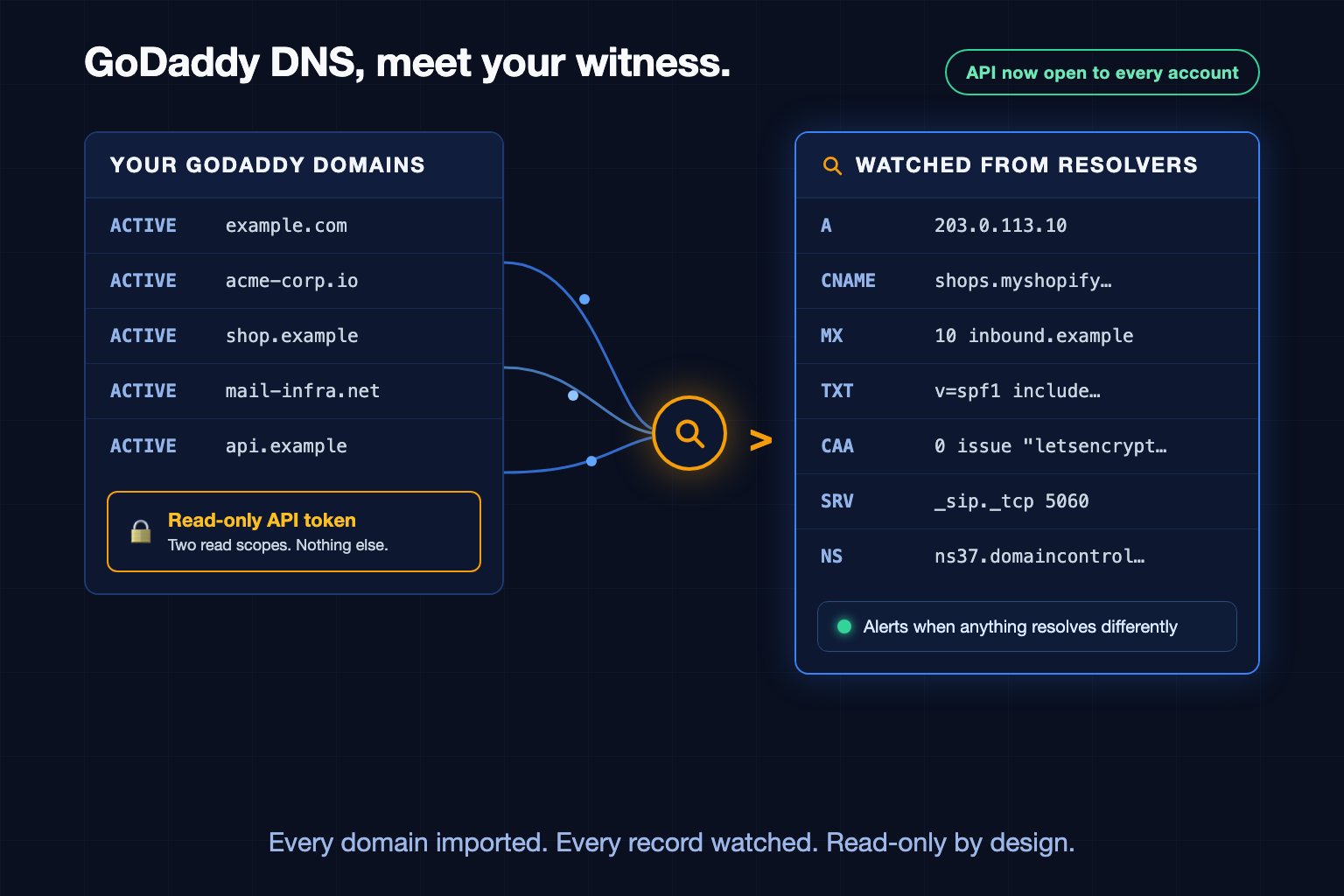
The connection uses a GoDaddy Personal Access Token carrying exactly one scope: domains.domain:read, which lists the domains in your account and reads their DNS records. A token scoped that way cannot edit a record, transfer a domain, renew anything, or spend a cent. It reads your zones — that is the entire blast radius.
Creating the token in the GoDaddy Developer Portal takes about two minutes, and our setup guide walks through every click. The token is stored encrypted and never displayed again after saving.
Your Whole Account, One Import
GoDaddy accounts grow: the main business domain, the campaign microsites, the defensive registrations, the idea someone bought at 1 a.m. Connect once and DNS Spy lists every active domain in the account — tick the ones you want and each imports with its complete record inventory, including the unusually named records no autodiscovery wordlist would ever guess.
Then it stays current. DNS Spy re-reads your GoDaddy zones on a recurring schedule, so a record you add next month is monitored within hours, automatically. And if a record is deleted at GoDaddy, DNS Spy never quietly drops it from monitoring — it alerts you that the record stopped resolving, because a silently disappearing record is exactly the event a DNS monitor exists to catch.
The Dashboard Is Not a Witness
The GoDaddy dashboard shows what your records are supposed to be. It does not tell you when one changes at 2 a.m., whether every nameserver is serving the same answer, or that an A record got rewritten during a support call or a website product migration. DNS Spy uses the API only to discover which records exist; the values it monitors come from live queries against your authoritative nameservers, from resolver locations around the world.
That means you are watching what your users, your mail, and your certificates actually see. When reality diverges from intent — a hijacked login, a mis-clicked delete, a stale record pointing at hosting you cancelled last year — you get an alert through email, Slack, Discord, or PagerDuty, with a versioned history of what the record was before.
Get Started
Follow the GoDaddy setup guide — token scopes included.
Connect under Team Settings → DNS Providers, test the connection, and import your domains.
Or learn how provider sync works on the DNS Provider Sync feature page.
GoDaddy joins Cloudflare, Amazon Route 53, DNSimple, DigitalOcean, Bunny DNS, Linode/Akamai, and Vultr — eight providers, one read-only connection each, complete monitoring coverage on every paid plan and during trials. If your provider is not on the list yet, tell us which one should be next.
GoDaddy is a trademark of GoDaddy Operating Company, LLC. Provider names are trademarks of their respective owners. DNS Spy is not affiliated with or endorsed by these providers.