
The Records You Cannot See From Outside
UltraDNS, now part of DigiCert, runs DNS for some of the largest organisations in the world, and zones at that scale are rarely small. They hold hundreds of records added over years by network teams, security teams, agencies and managed service providers. From the outside, a monitoring service can only find the records it thinks to ask for: the common hostnames, the obvious mail and verification records. The provider knows all of them.
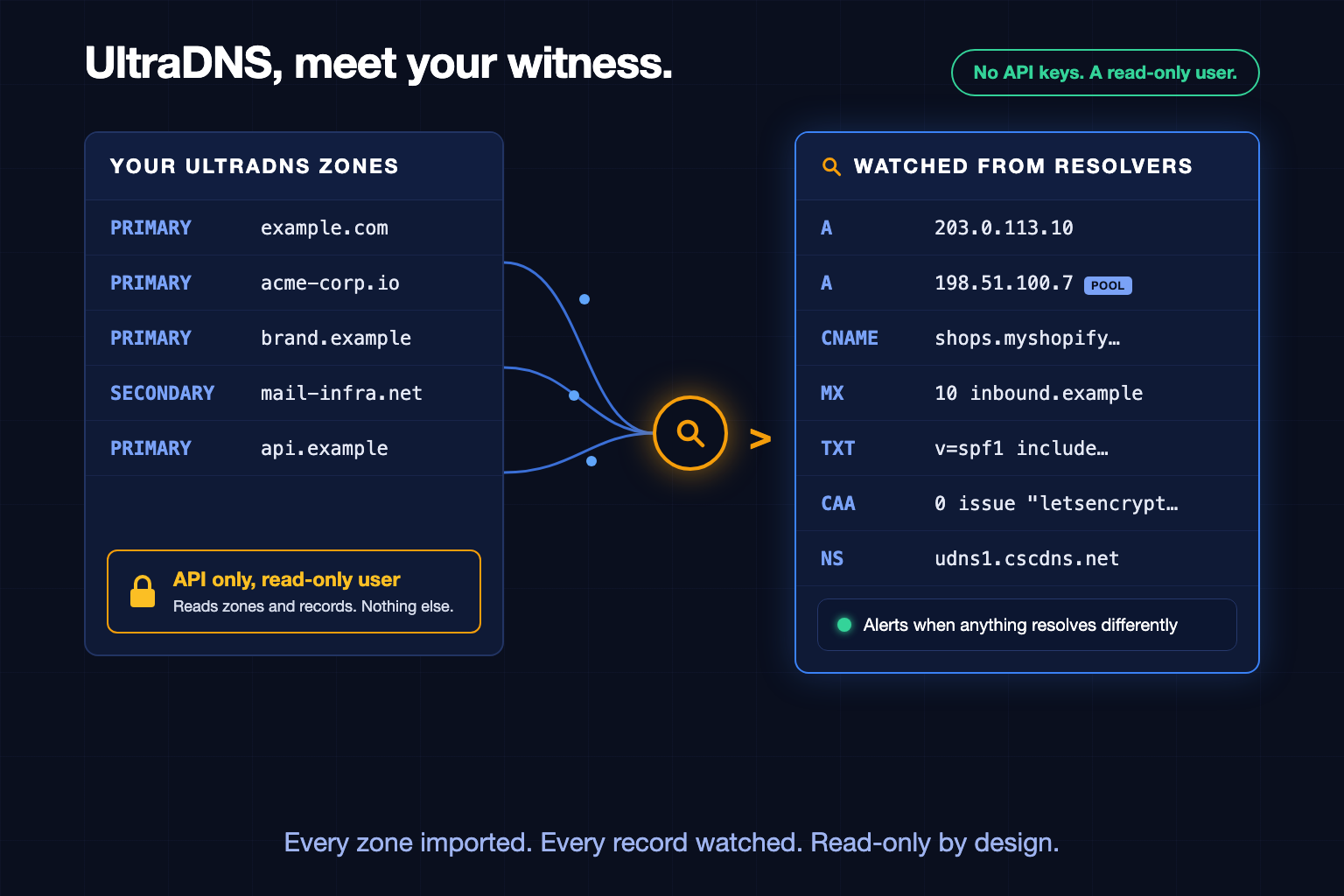
Connecting UltraDNS closes that gap. DNS Spy reads the complete record list for every zone straight from UltraDNS, puts every record under monitoring, and re-checks on a schedule so anything added later is picked up automatically. The forgotten subdomain and the verification record nobody remembers creating are watched from the first scan.
UltraDNS Has No API Keys
The first surprise for anyone automating UltraDNS is that there is no API key to create. Its REST API signs in with a username and password and returns a token that lasts about an hour. That changes what a careful integration looks like, because the credentials you hand over are a real user.
So DNS Spy asks for a dedicated user with three properties:
API only access. The user can call the API but cannot sign in to the UltraDNS portal.
Read-only permissions. DNS Spy lists zones and reads records. It never writes, and with a read-only user UltraDNS would refuse a change anyway.
Two-factor off for that user only. UltraDNS refuses API sign-ins from users with Two Factor Mobile Authentication on. Because the dedicated user cannot reach the portal, your own login keeps two-factor enabled.
The credentials are stored encrypted and never shown again. The hour-long token is kept encrypted too and reused for its full life, which is what UltraDNS asks integrations to do.
It Works Through CSC, Too
Many companies get UltraDNS through CSC as part of a managed domain portfolio. If your nameservers end in cscdns.net or cscdns.uk, that is very likely you. Those accounts are managed in the standard UltraDNS portal, so the same connection works: if you can sign in at portal.ultradns.com, you can create the API user DNS Spy needs.
Traffic Steering Without the Noise
UltraDNS is known for pools: SiteBacker failover, Traffic Controller, and Directional records that answer differently depending on where the question comes from. Compare the stored pool members with one resolver's answer and you would be alerted all day by a system working as designed.
DNS Spy imports those records for coverage and monitors them by what resolvers actually return, the same way it treats proxied records at other providers. Standard records and round-robin pools are compared value for value. Apex alias records are not imported yet.
Get Started
Follow the step-by-step UltraDNS guide to create the API user and connect it.
See what the connection covers on the UltraDNS provider page.
Read how provider connections work on the DNS Provider Sync feature page.
UltraDNS joins Cloudflare, Amazon Route 53, GoDaddy, DNSimple, DigitalOcean, Bunny DNS, Linode/Akamai, and Vultr. Nine providers, one read-only connection each, and every record watched. If your provider is not on the list yet, tell us at support@dnsspy.io.
UltraDNS is a DigiCert product. UltraDNS and CSC are trademarks of their respective owners. DNS Spy is not affiliated with or endorsed by DigiCert or CSC.