
On November 5, 2026, Alex Shakhov of SH Consulting published research into dangling DNS records on US state and local government domains. The team scanned 25,964 government-related domains and reported 43 that still reference domains outside their control: expired, mistyped or repurposed names sitting in SPF, MX, DMARC and nameserver records. YesWeHack later featured the work in its Bug Bounty Bulletin #22.
One of those findings was shared on LinkedIn as a screenshot of a single dig command against a .gov registry server. The answer listed two nameservers for a government domain:
$ dig @a.ns.gov example.gov NS +norecurse +noall +authority
example.gov.   10800   IN   NS   ns41.domancontrol.com.
example.gov.   10800   IN   NS   ns42.domaincontrol.com.
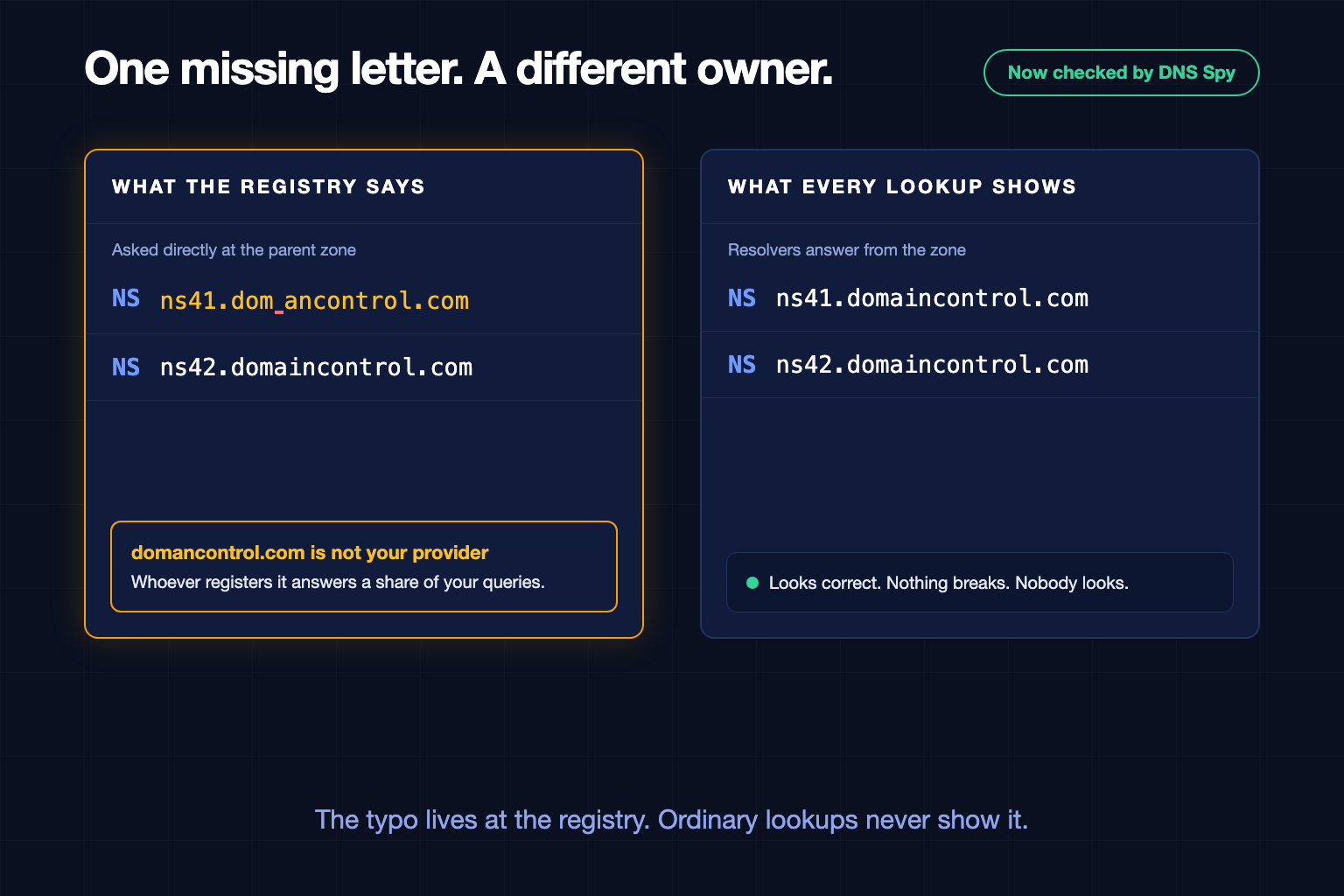
Read the first line again. It says domancontrol.com, with no "i". The second line has the name spelled correctly. Somebody typed two nameservers into a registrar form and missed one letter in one of them. We have replaced the real domain with example.gov here. The nameserver names are as they appeared, and the original research lists the domains it found.
The point made in that LinkedIn post was that nobody pays for reports like this, because the fix takes five minutes. We agree that this is the wrong way to measure it. We also had a more uncomfortable question to answer: would DNS Spy have caught this? We traced it through our own code. The answer was no. This post explains why, and what we shipped to change that.
Two Lists of Nameservers, and Only One Gets Looked At
Every domain has its nameservers written down in two places.
The registry delegation. This is the list your registrar submits to the parent zone, such as .com or .gov. It is how the rest of the internet first finds your domain.
The NS records in your own zone. This is the list your nameservers publish about themselves.
The two are supposed to match. Nothing enforces that. And when you ask an ordinary resolver for the NS records of a domain, it answers from the zone, not from the registry. So does nearly every DNS lookup tool and most monitoring. The registry side is only visible if you ask a parent nameserver directly, with recursion turned off, and read the authority section of the reply.
That is why a typo at the registry can sit for years. Every tool anyone is likely to run shows the correct list.
Why Nothing Breaks
Resolvers pick among the delegated nameservers and retry when one fails. If one of two names goes nowhere, queries sent to it time out and the resolver quietly uses the other. The domain keeps working. Lookups are a little slower some of the time. There is no outage, no ticket, and nobody with a reason to go looking.
The mistake only becomes visible on the day somebody else notices it.
What a Stranger Gets
If the misspelled domain is not registered, anyone can register it for the price of a domain. If they then run a nameserver under the misspelled hostname, a share of all queries for the victim domain arrives at their server. They can answer those queries however they like.
Point the website at a server they control, for the visitors whose resolvers happened to ask them.
Publish MX records and receive a share of the inbound email.
Pass domain validation and obtain a TLS certificate for the name.
Publish their own SPF and DKIM records so that mail they send passes authentication.
On a government domain, that is a trusted name that citizens have no reason to doubt. And none of it requires breaking into anything. The attacker registers a domain that was for sale.
Why DNS Spy Would Have Missed It
DNS Spy has had an NS Record Consistency check for a long time. It compares the NS records in your zone against the nameservers found by resolving your domain. Both of those lists come from the zone side. A hostname that is wrong only at the registry appears in neither, so the check passes.
Our own knowledge base article for that check said it compared against the parent delegation. It never did. We have rewritten the article to say what the check does and what it does not.
We could have left a comment on the post saying that monitoring catches this sort of thing. It would not have been true, so we built the check first.
What We Built: Delegation Consistency
The new Delegation Consistency check asks a parent nameserver directly for your delegation, the same way the dig command above does. If the parent cannot be reached, it falls back to the nameservers in a recent WHOIS record. It then fails on any of three conditions.
The registry and the zone disagree. A nameserver appears in the delegation and not in your NS records, or the other way round.
A nameserver sits on a domain that is not registered. This is the critical case. Anyone can buy that domain and start answering for yours.
Two nameserver domains are a near miss of each other. One is very likely a typo of the other.
The third rule exists because of what we found when we ran the first version against the real domain.
The Live Case Was Worse Than the Screenshot
We expected a domain that worked normally, with a correct zone and one bad name at the registry. That is not what we found when we looked on November 23, 2026.
The registry still delegates to the misspelled nameserver.
The correctly spelled nameserver refuses queries for the domain, so the domain does not resolve at all.
The misspelled domain is no longer available. It was registered on August 27, 2026.
We do not know who registered it. SH Consulting says it defensively registered 17 of the dependencies it found, but it describes those as SPF, MX and DMARC reporting domains, not nameserver domains. Its write-up says no abuse of this nameserver has been confirmed. Whoever holds the name, consider what that state means for a check. There is no zone to compare against, and the test for an unregistered nameserver domain does not fire, because the domain is now registered. A check built only on the obvious rules would have reported nothing wrong.
So the check also judges the delegation on its own. When two nameserver domains in the same delegation share a suffix and differ by a character or two, it flags the pair and names the one that looks like the typo. Run against the real domain, it fails and reports domancontrol.com beside domaincontrol.com.
One government domain is the example here, but the same slip has been made many times. The research cites Infoblox DNS data showing that 87 domains have delegated to nameservers under that one misspelled name over the years.
We tuned that rule against real providers before shipping it. Plenty of legitimate delegations use nameserver domains that look alike on purpose: the same provider name under several country suffixes, or numbered pools that differ only by a digit. Those are not flagged.
How to Check Your Own Domain
You need two commands. First, ask a nameserver for your parent zone what it delegates. For a .com domain:
dig @a.gtld-servers.net yourdomain.com NS +norecurse +noall +authorityFor another suffix, find a parent nameserver with dig NS followed by the suffix, and use one of the names it returns. Then ask for the NS records the normal way:
dig yourdomain.com NS +shortCompare the two lists character by character. Then look at each nameserver hostname and ask who owns the domain it sits under. If you cannot answer that, or the domain turns out to be unregistered, treat it as urgent.
The fix is the five minutes the LinkedIn post described: correct the nameserver list at your registrar, make the zone match, and confirm with the first command once the registry has updated.
Where This Lives in DNS Spy
Delegation Consistency runs in the Security Center on the Enterprise plan. It reads the registry delegation for every monitored domain every few hours and reports a critical finding for an unregistered nameserver domain. The knowledge base article walks through the scenario and the fix in more detail.
Credit goes to Alex Shakhov and SH Consulting, who did the work, and to YesWeHack for giving it an audience. Their write-up covers far more than nameservers, including mistyped SPF and MX dependencies and abandoned DMARC reporting addresses, and it is worth reading in full. They reported their findings to CISA and MS-ISAC, and an update dated November 11 says the .gov registry team is contacting the affected registrants.
A report that takes five minutes to fix and exposes a government domain to takeover is not a small report. It also showed us a gap in our own product, and we would rather be told.
If you want a quick read on your own domain, the free scan checks your live DNS, nameservers, SSL and email authentication records with no account required.