
The past five weeks brought two sets of serious vulnerabilities in software that most of the web runs on. PHP fixed a pair of remote code execution bugs known as PHP2Shell on October 21, 2026, and a third issue, phpAfterShell, on November 19. In between, on November 18, nginx fixed two memory corruption bugs in its HTTP/2 code.
Each time, teams everywhere had the same question: are any of our servers in the affected range? We asked it on behalf of our customers. This post covers what was disclosed in nginx and in PHP, how to fix each, and how two response headers let us find the customers who might be affected and contact each of them personally.
The nginx HTTP/2 Vulnerabilities
The nginx security advisories list two separate bugs in the same part of the server.
CVE-2026-123007 is memory corruption in HTTP/2 flow control. nginx can miscalculate how much response data an HTTP/2 client has allowed it to send, which leads to an invalid memory copy. It affects nginx 1.9.5 through 1.31.8, so the bug has been in the code since 2015.
CVE-2026-123633 is a use-after-free in HTTP/2. A connection can be marked reusable while a request is still active on it, then freed underneath that request. It affects nginx 1.19.7 through 1.31.8 and matters most when nginx is proxying requests to a backend.
Both need HTTP/2 to be enabled. A server that only speaks HTTP/1.1 is not exposed. Sources rate them differently: the nginx project calls the first major and the second medium, while Red Hat rates both as critical impact and Wiz gives both a CVSS 4.0 score of 9.2. The outcome researchers demonstrated is code execution inside the nginx worker process.
Rapid7 published its research on CVE-2026-123007 with a proof of concept. It is not a one-packet exploit. Rapid7 describes pushing roughly 128 GB of HTTP/2 data through a single connection, which takes a fast link and a server that keeps the connection open long enough. That raises the bar for an attacker without removing the risk. None of the sources we read reported exploitation in the wild at the time of writing.
The fix: upgrade to nginx 1.30.7 on the stable branch or 1.31.9 on mainline, then restart nginx. If you cannot upgrade today, turning HTTP/2 off closes both bugs until you can. On nginx 1.25.1 or later:
server {
    listen 443 ssl;
    http2 off;
}
On older versions, remove the http2 parameter from your listen lines, then reload. Do not do this on a gRPC frontend, because gRPC needs HTTP/2. NGINX Plus is affected as well and has its own fixed releases, so check the F5 advisory for your branch.
The PHP Vulnerabilities: PHP2Shell and phpAfterShell
PHP had the harder month. There are three CVEs across two disclosures, and they need two separate updates.
PHP2Shell, CVE-2026-109618. PHP can run out of memory partway through setting up a request and leave its internal state corrupted. An attacker who sizes a request to hit the memory limit at the right moment can turn that into code execution.
PHP2Shell, CVE-2026-109619. A use-after-free in which state left behind by one request points at freed memory that a later request on the same worker can reach.
phpAfterShell, CVE-2026-126714. PHP's default file based session handler writes new session data over the old file without clearing it first. If the write is interrupted, the file can hold part of the new session followed by part of the old one, and crafted content can then be read back as objects. With a suitable gadget chain in the application, that becomes code execution.
PHP2Shell is the urgent one. The PHP security team rates both CVEs 9.2 on CVSS 4.0. Datadog's analysis found the attack works in default PHP configurations and never reaches the application's own code, so authentication and input filtering in your application do not help. Every web setup is in scope, including Apache with mod_php and PHP-FPM. Tenable reports that CISA added both CVEs to its Known Exploited Vulnerabilities catalog on October 26, and several honeypot operators have reported exploitation attempts.
phpAfterShell is a separate bug, and this is the part that is easy to miss: the October PHP2Shell releases do not contain its fix. A server patched for PHP2Shell in October still needs the November release. PHP's advisory rates it critical, also 9.2. It needs more to go right for an attacker, including some influence over stored session data and a usable gadget chain in the application. Neither PHP nor the reporter had reported attacks at the time of writing. Session stores that replace a record in one step, such as Redis or a database, are not affected by this one.
The fix: these are the releases that close all three.
PHP 8.5: update to 8.5.13 (PHP2Shell was fixed in 8.5.12)
PHP 8.4: update to 8.4.28 (PHP2Shell was fixed in 8.4.27)
PHP 8.3: update to 8.3.37 (PHP2Shell was fixed in 8.3.36)
PHP 8.2: update to 8.2.36 (PHP2Shell was fixed in 8.2.35)
Restart PHP-FPM or your web server workers after updating. Older branches are a bigger problem. PHP 8.1 and earlier are end of life and get no official releases. For PHP2Shell, the PHP security team published source backports for 7.4, 8.0 and 8.1 for people who build from source, and some distributions and long term support vendors ship their own. There is nothing from the PHP project for 7.3 and older, and no fix is planned for phpAfterShell on any end of life branch. The dependable answer for those sites is to move to a supported branch.
If you cannot update immediately, turning off session upload progress removes one input path used by both PHP2Shell and phpAfterShell:
session.upload_progress.enabled = 0
Set it in php.ini or the PHP-FPM pool configuration and restart every worker. PHP is explicit that no configuration change fully mitigates these bugs, so treat this as buying time, not as a fix. The watchTowr FAQ and Cycode's write-up are good references for the details.
How We Found Customers Who Might Be Affected
Web Watch visits the websites behind our customers' DNS records. It takes screenshots and judges whether a page still looks like the customer's site, and on every visit it also records what the server says about itself: the Server header, the X-Powered-By header, and the generator tag in the page. Those values are stored with each observation, and Web Watch already raises a finding called Software version disclosed when one of them includes a version number.
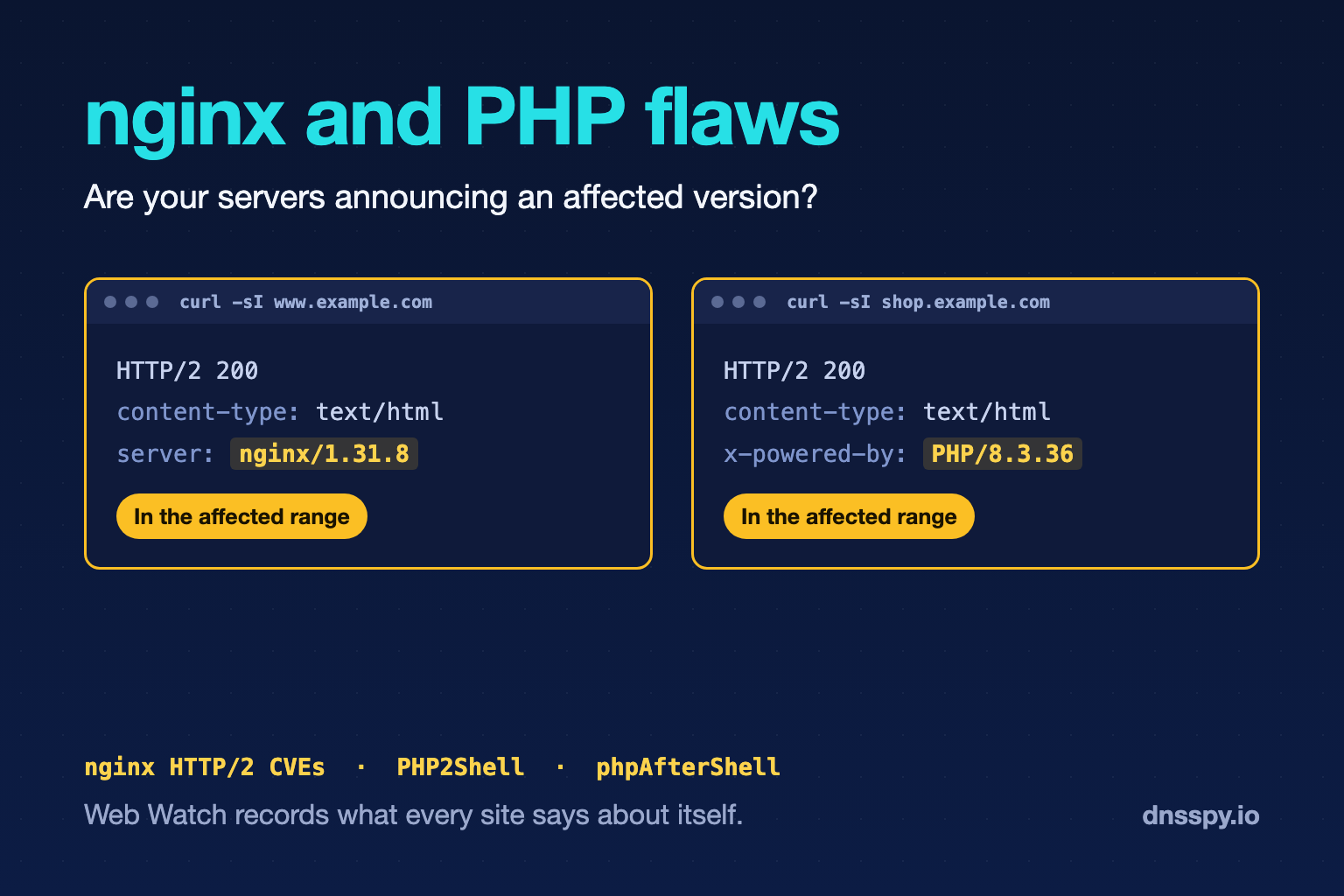
That history is what made this quick. We did not need to scan anything new. We looked at the most recent observation for every monitored hostname and compared what each one announced against the affected ranges. The Server header answered the nginx question and the X-Powered-By header answered the PHP question:
$ curl -sI https://www.example.com | grep -iE '^(server|x-powered-by)'
server: nginx/1.31.8
x-powered-by: PHP/8.3.36
That example is in range twice. The nginx version is affected by both HTTP/2 CVEs, and PHP 8.3.36 has the PHP2Shell fix but not the phpAfterShell fix. The PHP results were the more sobering of the two. Alongside sites that were one point release behind, we found sites still announcing end of life branches, including PHP 5.
We then wrote to each of those customers personally. Every message listed their own hostnames, the version each one announced, which vulnerability applied to it, and the steps above.
What a Banner Can and Cannot Tell You
We were careful about how we worded those messages, and the same care applies if you run this check yourself.
A banner is a claim, not a test. We read the version a server announces. We did not probe for the vulnerability, and we would not do that to a customer's server.
A patched server can still show an old version. Distribution packages of both nginx and PHP often carry a fix under the original version number. A matching banner means check this host, not this host is vulnerable.
A hidden version tells you nothing. Many servers send only
Server: nginx, most PHP sites send noX-Powered-Byheader at all, and anything behind a CDN shows the CDN's banner. We could not assess those hosts either way, so silence from us is not a clean bill of health.We cannot see configuration. Whether HTTP/2 is on, or which session handler PHP uses, is something only the operator can read.
So the message to each customer was that these hosts may be affected and are worth a look. That is the most a banner supports, and it was still enough to put the right hostnames in front of the right people.
Stop Announcing Your Versions
The check that helped our customers is the same check an attacker runs. After a disclosure, mass scanners search the internet for the exact vulnerable version strings and work down the list. A server that announces nginx/1.31.8 or PHP/7.4.33 puts itself on that list.
Hiding both takes two lines. In the http block of your nginx configuration, followed by a reload:
http {
    server_tokens off;
}
And in php.ini, followed by a restart of PHP-FPM or your web server:
expose_php = Off
The first reduces the header to Server: nginx. The second removes the X-Powered-By header. On Apache, ServerTokens Prod and ServerSignature Off do the same job as server_tokens.
None of this is a fix. A hidden version is still a vulnerable version, and a determined attacker can fingerprint a server in other ways. Patch first. Then remove the banners so that the next disclosure does not start with your hostname in someone's search results.
Check Your Own Sites
For a handful of hostnames, the curl command above is all you need. Run it against every public hostname, including the staging, webmail and admin subdomains that people forget about. Those were well represented in what we found.
If you have more hostnames than you can check by hand, this is what Web Watch does on its own. It finds the websites behind your DNS records, records what each one announces, flags any that disclose a software version, and keeps the history so that the next advisory is a lookup instead of a scramble. Web Watch is part of DNS Spy Enterprise. You can read more on the Web Watch feature page or start a trial.